How do I create a column that sums the total of each row based on the invoice #, but leave the other rows blank. So it doesn’t repeat itself?
| Column 1 | Column 2 | Column 3 | Column 4 |
|---|---|---|---|
| Inv1 | $10 | $45 | |
| Inv1 | $15 | ||
| Inv1 | $20 | ||
| Inv4 | $2 | $9 | |
| Inv4 | $3 | ||
| Inv4 | $4 |
How do I create a column that sums the total of each row based on the invoice #, but leave the other rows blank. So it doesn’t repeat itself?
| Column 1 | Column 2 | Column 3 | Column 4 |
|---|---|---|---|
| Inv1 | $10 | $45 | |
| Inv1 | $15 | ||
| Inv1 | $20 | ||
| Inv4 | $2 | $9 | |
| Inv4 | $3 | ||
| Inv4 | $4 |
You can’t sum data with $ signs. They’re strings. Save your data as numbers.
Hey there,
in addition to what @rfeigel said - can you explain a little more (or even better provide an example) about what the desired output is?
Based on your current explanation I am unsure whether you’d like to see e.g. for your first row 55 in a new column and second row 15 or if you want to sum all cells that are in an Inv1 row (i.e. see a total of 90).
Regards,
Martin
Hi @vivianmpoon.
After converting Column2 to number, this is my aproach.
Generate totals.
Use a group by node to sum values on Column2 agregated by same value on Column1.
Rename the sum as Column3
Append Column3 generated on 1)
Use a join node to (left join) by column1, to append that Column3 result.
Remove values if same invoice.
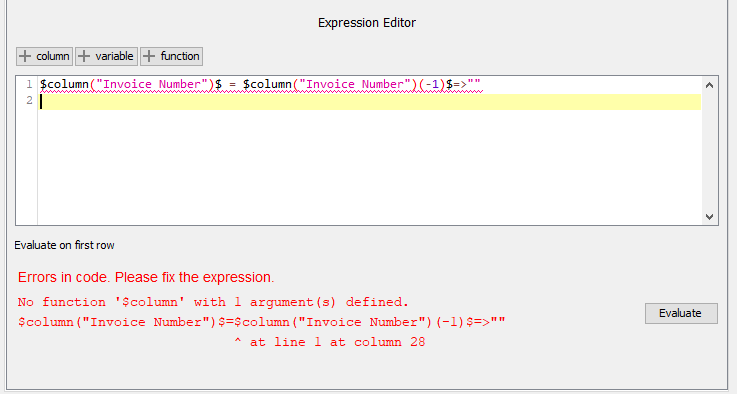
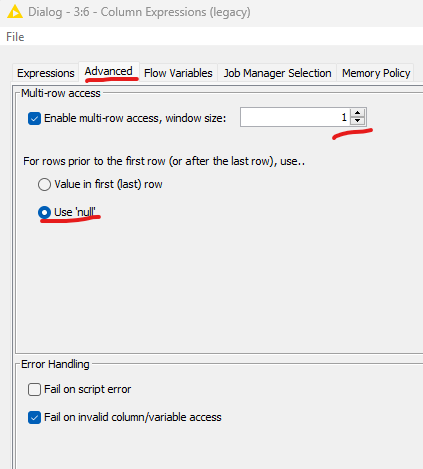
Use a column expression node to relace Column3 and suppress values if same invoice
$Column1$ = $Column1(-1)$ =>“”
Br
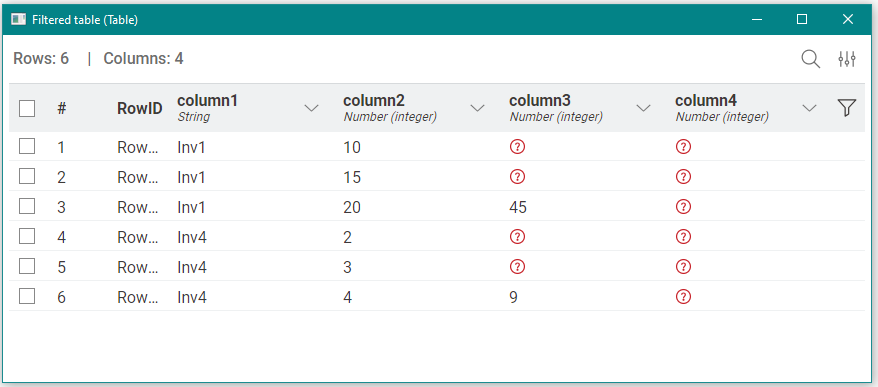
So when I do a groupby node to calculate the sum of each invoice amount, it gives me the totals. Then I use a joiner node to bring the total back to the original table, but the total sum of each line will keep repeating itself as per below.
How do I make it so that column 3 (the grand total of each invoice #) only repeats itself once?
| Column 1 | Column 2 | Column 3 | Column 4 |
|---|---|---|---|
| Inv1 | 10 | 45 | |
| Inv1 | 15 | 45 | |
| Inv1 | 20 | 45 | |
| Inv4 | 2 | 9 | |
| Inv4 | 3 | 9 | |
| Inv4 | 4 | 9 |
@hmfa solved your problem.
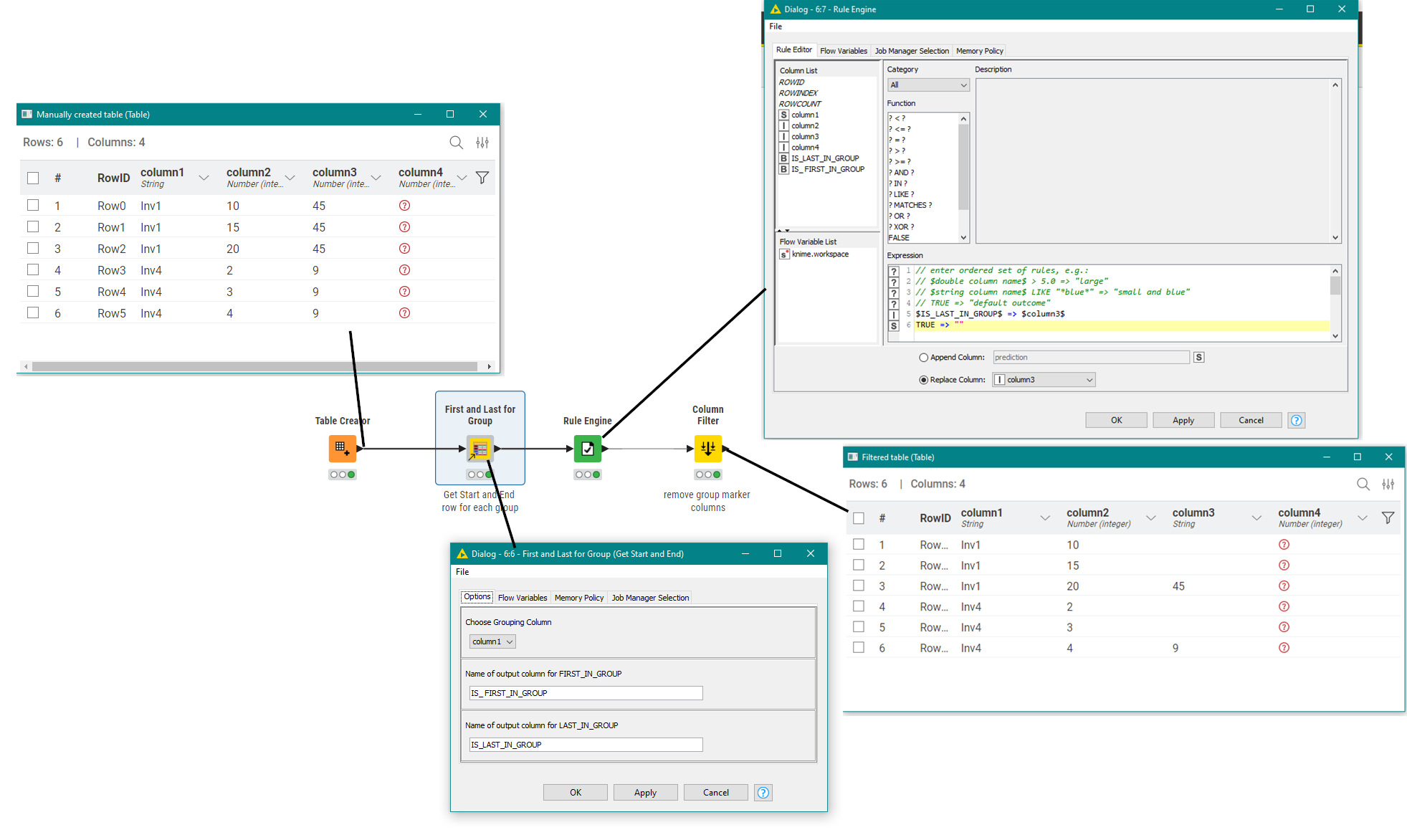
If you are ok with download components, and want a quick way of finding the final row for each invoice, I have a component First and Last for Group which will do that.
You tell it which column identifies the “group” (in your case Column1 with the invoice number)
Then similar to @hmfa’s approach, a Rule Engine blanks the “other” row values.
Of course your output will have to be a string, because otherwise it cannot be set to blank. The best you could do for Integer is to have missing values instead of blanks , by leaving out the final line in my Rule Engine example.
Hello @vivianmpoon
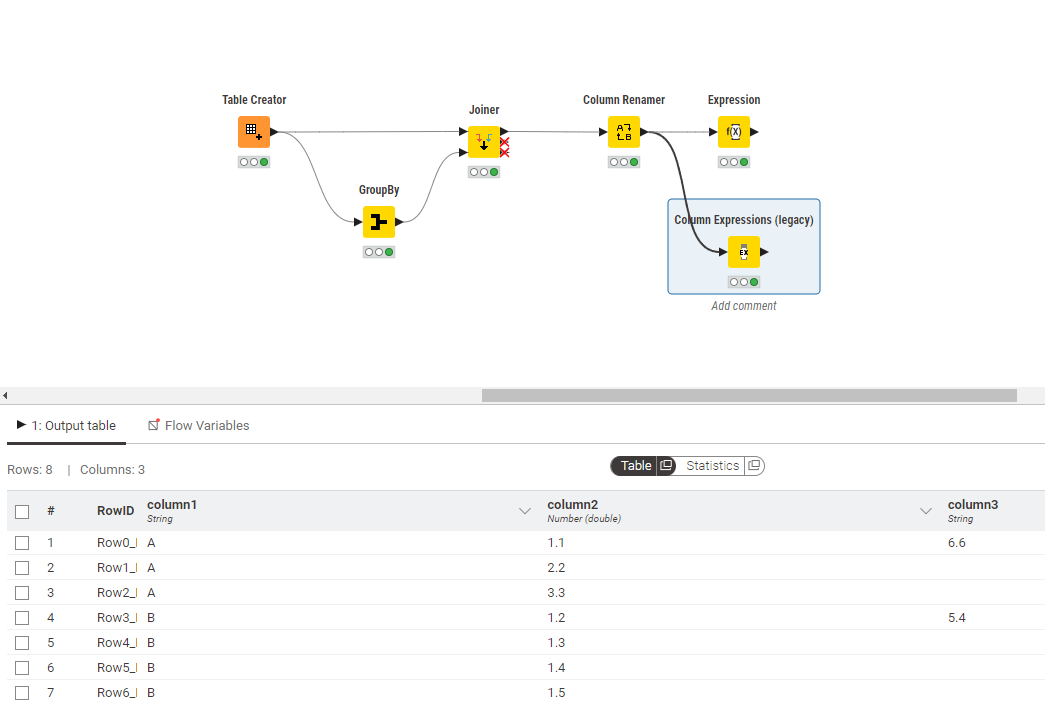
I couldn’t avoid a take to this challenge. @hmfa 's workflow is the simplest approach to it; I’ve tested to process the cumulative computation with ‘Moving Aggregator’ + ‘Column Expressions’ node.
It may look too complex for a single column; but it escalates quite easy for complex logistics , as you see in this post. This approach avoids loops and joiners increasing in efficiency.
BR 
This topic was automatically closed 90 days after the last reply. New replies are no longer allowed.