Hi, folks! We’re back with another Just KNIME It! challenge on traveling and planning! Can KNIME help you have more fun in your vacations?
The end of the year is coming and you are finally ready to organize a roadtrip around Europe! To facilitate its planning, you decide to create some interactive dashboards to (1) identify a network of cities that are connected by at most a given distance (e.g., at most 200km apart from one another), (2) display different properties of each city in this network (e.g., which city is more central?), and (3) calculate the shortest paths between two selected cities in this network. Which cities will be a part of your itinerary?
Here is the challenge. Let’s use this thread to post our solutions to it, which should be uploaded to your public KNIME Hub spaces with tag JKISeason4-27 .
Need help with tags? To add tag JKISeason4-27 to your workflow, go to the description panel in KNIME Analytics Platform, click the pencil to edit it, and you will see the option for adding tags right there. Let us know if you have any problems!
Read and clean the data (unpivot to get the relation, remove 0 as it is distance to same city, getting unique city names, and removing duplicates distance such as Barcelona to Madrid and Madrid to Barcelona)
Then creating a Network with various properties.
Adding the possibility to define a max number of kms, and filtering the network
Then we extract the shortest path between City A to City B.
Getting the trip from A to B and the distances and total distances.
From there, some visualization and interaction to handle errors (e.g., no trip available between the cities within the defined distance)
Table View to explore the model statistics
This is one possible solution - I know I could improve even more the interactivity, but this is a start. I also decided to give the possibility to the use to select only the cities (for route planning) that are available after filtering the network based on a max kms.
For me this was the ultimate learning challenge. With this challenge I understood what I didn’t understood in the last challenge: why the network mining can be actually really useful. For example a critical path calculation which is crucial for a project manager. So for me this challenge is the TOP in this season. (yet? )
I’m sure that this could be really much more detailed way. I’m really open to suggestions, comments (I’m really into this network mining now, I’m really enthusiastic ).
Find my Submission … not so sophisticated like other while tried my Bit.. Network graph is really a robust to understand the complex data..though more variable and maneuver to get the clean draft. I tried E chart just to visualize and that was just in a fizzy to attempt and get the neat graph.
I could not finish last week’s challenge on time, but I nonetheless took the time to finish it this week to understand that “network thing”. I’m glad I did since it is the foundation of this Traveling To Europe challenge. That is a very good idea to build up on previous challenge!
So here is my solution. I have considered that the max distance is not the total max distance for the trip, but rather the max distance between each hop.
This was definitely a challenging exercise and I’m not sure if I correctly address the problem statement but I did try my best. I also had to leverage from @trj@jproudfoot111@AnilKS and @berti093 to get an idea how to tailor my specific workflow.
I broke out the solutions (attempted) into two rudimentary components:
The second visualization was setup to address the second aspect of this challenge.
I don’t think I got the right parameters setup in the component as I think this aspect of the challenge might be beyond my scope…but it was fun to try.
Our solution to last week’s Just KNIME It! challenge is out!
Thank you all for diving even deeper in the network mining world, focusing on important techniques such as shortest paths and network property calculation. We loved to see your visualizations, and how you were able to combine your sharp dataviz skills with this (slightly) more niche type of data.
Tomorrow we come back with a challenge on data profiling, so we can better understand when we can trust data that we scrape, for example, in terms of quality. We’re already looking forward to your profiling ideas!
 Hi, folks! We’re back with another Just KNIME It! challenge on traveling and planning! Can KNIME help you have more fun in your vacations?
 The end of the year is coming and you are finally ready to organize a roadtrip around Europe! To facilitate its planning, you decide to create some interactive dashboards to (1) identify a network of cities that are connected by at most a given distance (e.g., at most 200km apart from one another), (2) display different properties of each city in this network (e.g., which city is more central?), and (3) calculate the shortest paths between two selected cities in this network.
  Which cities will be a part of your itinerary?
 Need help with tags? To add tag JKISeason4-27 to your workflow, go to the description panel in KNIME Analytics Platform, click the pencil to edit it, and you will see the option for adding tags right there.
  Let us know if you have any problems!


 (yet?
(yet?  )
)


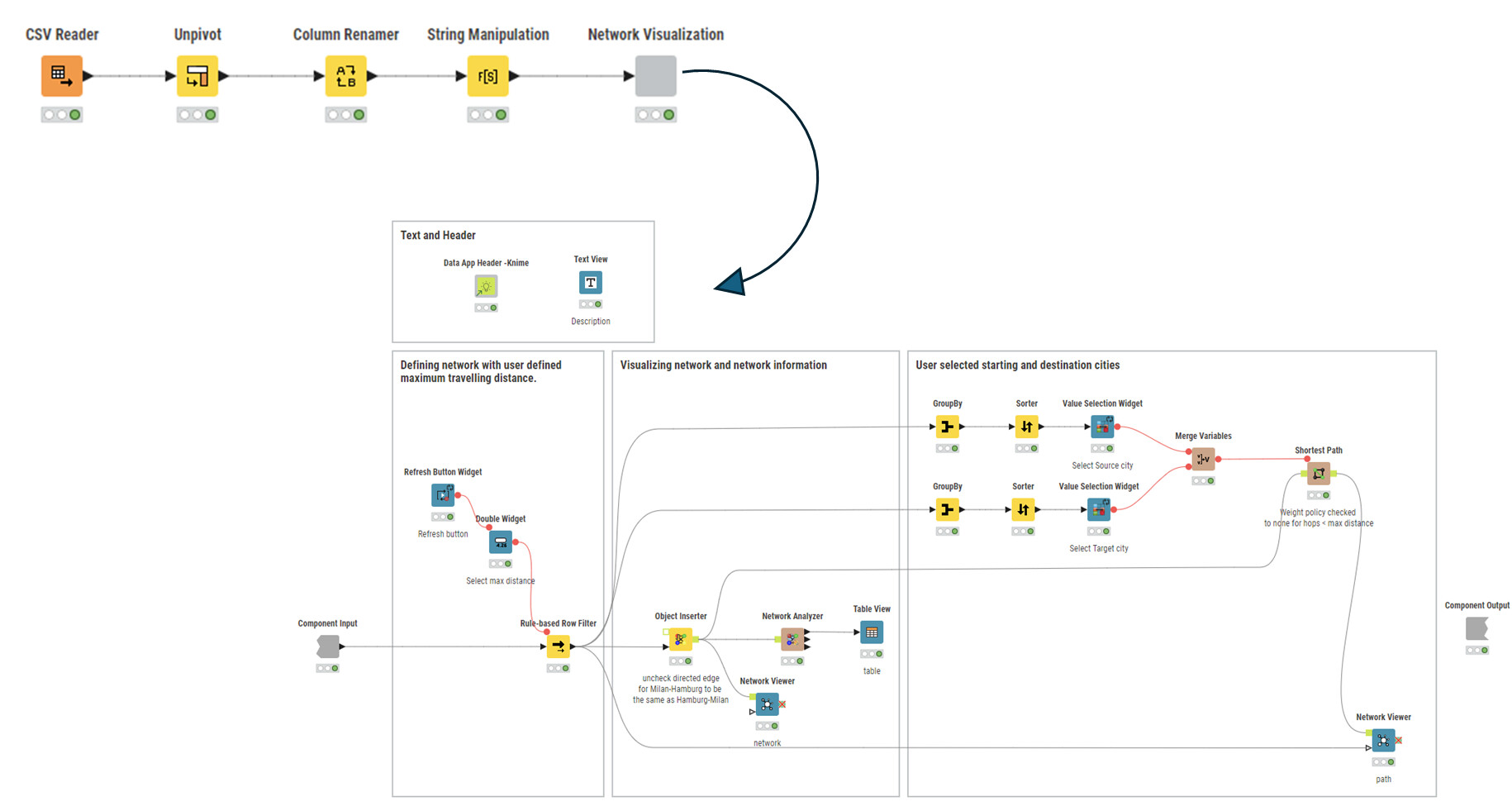


 Thank you all for diving even deeper in the network mining world, focusing on important techniques such as shortest paths and network property calculation.
  Tomorrow we come back with a challenge on data profiling, so we can better understand when we can trust data that we scrape, for example, in terms of quality. We’re already looking forward to your profiling ideas!